-

Eaton
C441CB
Overload Relay with User Interface (323 - 528 VAC Overload, 5-90A, 480 VAC)
$1,403.69 -

Eaton
EASY-E4-AC-12RC1
Programmable Relay
$295.26 -

Toshiba
GRO216**S
16 Output Digital I/O Module
-

Toshiba
V200 to TOSHIBA VFD (RS485, 4W)
V200 to TOSHIBA VFD (RS485, 4W)
$23.50 -

Toshiba
GDI216
Digital I/O Modules
-

Eaton
MFD-80
LCD Display Unit
$105.64$177.17 -

Eaton
MFD-80-B
LCD display unit with buttons
-

Toshiba
RC-P-009H-00
PLC Connection Cable
$28.44$35.00 -

Eaton
EASY512-AB-RC
Programmable Relay
-

Eaton
MFD-AC-CP4-500
Titan Display Module
-

Eaton
EASY410-DC-RE
Expansion Module
$493.48 -

Eaton
EASY512-AB-RCX
Programmable Relay
$195.65 -

Eaton
EASY719-AB-RC
Programmable Relay
-
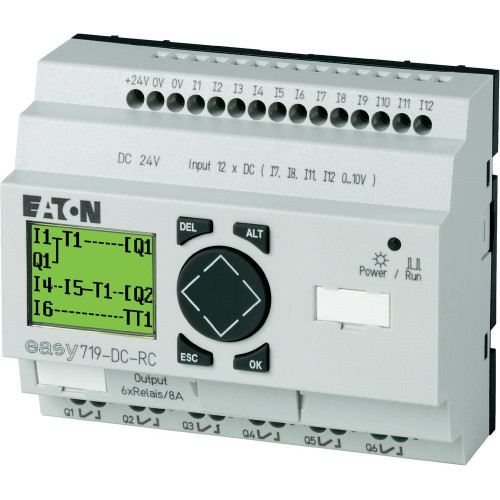
Eaton
EASY719-DC-RC
Programmable Relay
-

Eaton
EASY719-DC-RCX
Programmable Relay
-

Toshiba
V200 to TOSHIBA VFD (RS485, 2W)
V200 to TOSHIBA VFD (RS485, 2W)
$23.50 -

Eaton
C4410109NOUI
Overload Relay w/o Display (1-9A, 120V)
$2,417.38$2,886.41 -

Eaton
C441CA
Overload Relay (1-9A, 480V)
$1,028.41$1,297.89 -

Eaton
EASY512-AC-RC
Programmable Relay
-

Eaton
EASY512-AC-RCX
Programmable Relay (240V AC)
-

Eaton
EASY618-AC-RE
Programmable Relay
-

Eaton
EASY719-AC-RCX
Programmable Relay
-

Toshiba
IBM-H-005-00
Programming Cable
$28.20$30.00 -

Eaton
MFD-TA17
Programmable Relay
$238.04 -

Toshiba
OIS120A
Operator Interface Station (12" Screen)
$3,556.99 -

Toshiba
TRPADT0400
I/O Module (4 inputs)
$159.80$220.00 -

Eaton
C441BB
Overload Relay (5-90A, 240V)
$2,146.31 -

Toshiba
DIN Rail Connectors
DIN Rail Connectors
$1.88$2.00
What Is a Programmable Relay?
A programmable relay, also called a smart relay or programmable logic relay, is a compact, microprocessor-based controller that replaces hardwired relays, timers, and counters in small automation tasks. It reads its inputs, runs a user-written program, and switches its outputs accordingly. Most models are programmed in ladder logic or function block diagrams using PC software, and models with a built-in display can also be programmed from the front panel.
Programmable Relay vs PLC
Choose a programmable relay for small, standalone tasks with a modest number of inputs and outputs, such as lighting schedules, pump sequencing, or a simple conveyor. Choose a programmable logic controller (PLC) when the application needs high I/O counts, faster processing, multiple control loops, motion control, or integration with industrial networks such as EtherNet/IP or PROFINET and plant-wide SCADA systems. For a full comparison, see our guide to smart relays vs PLCs.
Common Applications for Programmable Relays
Programmable relays are widely used in building automation for lighting, ventilation, and HVAC interlocks, in water systems for pump alternation, tank level control, and timed sequences, and in light machinery such as conveyors, automatic doors, and packaging equipment. Built-in timers, counters, and, on most models, a real-time clock let one device replace several separate components.
Eaton easyE4 and easy Series Relays
The Eaton easyE4 is the current generation of Eaton’s easy programmable relays. Wistex stocks easyE4 base units and expansion modules, as well as the easy500, easy700, and easy800 series, so you can maintain existing installations or move to the current platform.
Programmable Relay FAQs
A smart relay repeatedly scans its inputs, runs the logic program stored in its memory, and switches its outputs on or off based on the result. Most models include timers, counters, and a real-time clock, so one unit handles functions that once needed separate devices. You program the unit on a PC, and models with a display can also be programmed or adjusted from the front panel.
Many models, including the Eaton easyE4, accept expansion modules that add digital or analog inputs and outputs. This lets a small system grow without replacing the base unit or rewriting the program from scratch.
Start with the number of digital and analog inputs and outputs the application needs, then match the supply voltage, AC or DC, to your panel. Choose relay outputs for switching AC or DC loads directly, or transistor outputs for fast, frequent switching of DC loads. Finally, decide whether you need a built-in display for setup and adjustments, or a blind unit programmed from a PC.