Soft Starter vs VFD: Which Motor Control Do You Need?
When it's time to control how an AC motor starts and runs, the soft starter vs VFD decision is one of the most common questions engineers and facilities managers face. Both devices protect motors and connected equipment, but they solve different problems, carry very different price tags, and are built for different jobs. In this guide, we'll break down how each one works, where they differ, and how to know which one belongs in your application.
What Is a Soft Starter?
A soft starter is an electrical device that manages voltage during motor startup. Instead of slamming a motor with full voltage and letting it draw a massive surge of current, a soft starter uses solid-state components called thyristors (or SCRs) to gradually ramp the voltage up over a set period of time. This limits inrush current, which can otherwise reach five to eight times a motor's rated current for a brief moment at start-up, and it softens the mechanical shock that hard starts put on couplings, belts, gearboxes, and piping.
Once the motor reaches full speed, most soft starters engage an internal bypass contactor, taking the electronics out of the circuit so the motor runs directly off line power. An important distinction is that a soft starter's job ends once the motor is up to speed. It has no ability to vary speed during operation, as it is only a starting and stopping device, not a speed-control device.
What Is a VFD (Variable Frequency Drive)?
A variable frequency drive (VFD) goes several steps further than the soft starter. Rather than only ramping voltage during startup, a VFD continuously controls both voltage and frequency throughout the motor's entire run cycle. Internally, a VFD converts incoming AC power to DC through a rectifier, filters it and then uses an inverter to convert it back to AC at the frequency and voltage the application requires. Since motor speed is directly tied to supply frequency, a VFD has full control over motor speed and torque from zero to maximum RPM, not just at startup.
That added capability comes at a cost. VFDs are more complex than soft starters, generate more heat, require more cooling and enclosure space, and carry a higher price tag for a given motor size. But for applications where speed needs to change based on demand, a variable frequency drive does something a soft starter simply cannot.
Soft Starter vs VFD: Key Differences
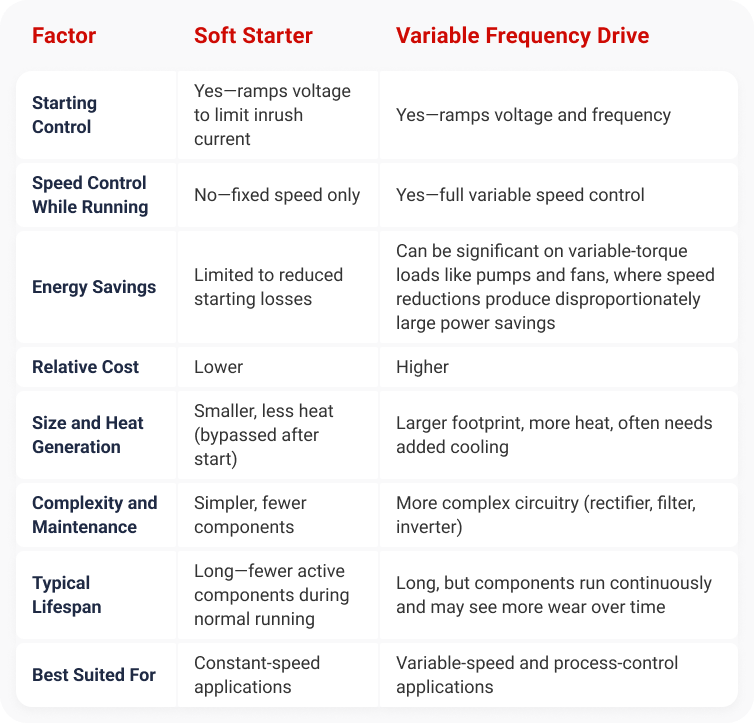
The energy story is worth unpacking a bit further, since it's often the deciding factor. For centrifugal pumps and fans, power draw follows the pump and fan affinity laws, in which power scales with the cube of speed. That means even a modest speed reduction can produce an outsized drop in energy use. For example, a fan trimmed to 80% speed can draw roughly half its original power. That cubic relationship is unique to variable-torque loads like pumps and fans.
Constant-torque loads, such as conveyors or positive-displacement pumps, see savings that are more nearly proportional to speed reduction, since torque demand doesn't drop as much at lower speeds. A soft starter, since it doesn't run at reduced speed, isn't positioned to capture either kind of savings.
When to Use a Soft Starter
A soft starter is the right call when a motor only needs smooth starting and stopping and runs at a constant speed the rest of the time. Pumps, fans, conveyors, and compressors that don't need speed adjustment are classic examples. The load runs the same way every time, so there's no operational upside to paying for speed control you won't use. In these cases, a soft starter delivers the inrush protection and mechanical stress reduction a facility needs, without the added cost and complexity of a full drive.
It’s also worth knowing that soft starter technology has evolved. Older units only voltage ramp, meaning they start the motor at a reduced voltage, typically 35-45% of full voltage, and increase it proportionally to 100% over the programmed acceleration time. Newer soft starters can combine that voltage ramp with current limiting, holding current to a defined threshold throughout the start rather than just controlling voltage. That combination cuts inrush current even further and saves more energy than a voltage-ramp-only start, which is worth factoring in when comparing soft starter models for a given application.
If you're weighing the different soft starter designs available, from primary resistor to Wye-Delta to solid-state, our comprehensive guide to soft starters walks through how each type works and where it fits best.
When to Use a VFD
A variable-frequency drive makes sense whenever an application requires variable-speed control, meaningful energy savings on a variable-torque load, or precise process control. Variable-flow pumping and machinery that have to adjust output to match changing demand are all strong candidates for a VFD.
A VFD is also the right tool when an application would benefit from overspeeding a motor. Most motors can safely run 5-10% above their base speed, and with a VFD, pushing past that baseline is a simple programming change rather than a hardware swap. Picture a car wash running blower motors to dry vehicles at the end of the line: if that blower stage is the bottleneck, overspeeding it by even 5% could mean ten more cars washed per hour, a direct gain in throughput and profitability. The one caveat worth building into any overspeed plan is checking the motor’s mechanical limitations with the manufacturer first, since not every motor is rated to run safely above its base speed.
Beyond speed control, VFDs also bring built-in motor protection, including safeguards against overcurrent, overvoltage, phase loss, and stall conditions, which can add real value even in single-speed retrofits where protection matters as much as speed. For a deeper look at sizing and setup configuration, check out our guide for using a VFD for three-phase motors.
Can a VFD Replace a Soft Starter?
This is one of the most common questions engineers ask, and the short answer is yes, technically. A VFD can perform every function a soft starter does, including a controlled soft-start function, plus everything else a VFD offers. But "can" and "should" aren't the same thing.
If an application will never need speed control, a VFD means paying for capability that will sit unused, along with extra heat, extra panel space, and a more complex piece of equipment to maintain. The right approach is matching the tool to the job. If speed control isn't part of the picture, a soft starter is usually the more cost-effective and appropriately sized solution.
How Wistex Can Help
Wistex stocks both soft starters and VFDs from major manufacturers, and our team can help engineers and facilities managers work through the soft starter vs. VFD decision for their specific application. Whether the priority is a simple, budget-conscious starting solution or full variable-speed process control, we can help match the right product to the motor, the load, and your operational goals.
The Bottom Line: Choosing the Right Fit for Your Application
The decision of soft starter vs. VFD comes down to one core question: does the application need to run at variable speeds, or just start and stop smoothly at a constant speed? A soft starter is the simpler, more cost-effective choice for fixed-speed applications, while a VFD is worth the added investment when speed control, energy savings, or precise process control are part of the job. Wistex can help evaluate your application and find the right fit either way.